Tuesday, April 13, 2010

Star effect from street lights

Venetian Causeway, Miami, FL, USA ( F=22, Exposure time=15 sec, ISO=400)

The "Star effect" is a stunning phenomenon in nocturnal photography that can be captured by reducing the aperture size (ie, increasing f-number) of a camera's lens whenever there is light source small enough when compared with the whole view. As a rule of thumb, selecting f-number greater than or equal to f/18 (i.e., f/18, f/20, f/22) makes the bright light sources like street-lights, vehicle lights, etc appearing like stars. The number of blades that make up the iris (or aperture) of the lens dictates the number of points on a star-burst.

Melbourne CBD (F=20, Exposure time=30 sec, ISO=100)

It has to be noted that shooting in the dark and small apertures results in very slow shutter speeds. Hence, a camera stabilizer, e.g., a tripod, is essential.
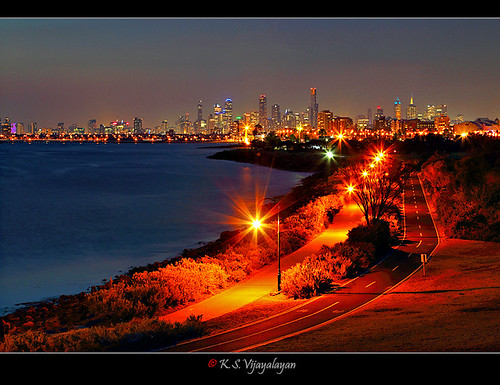
Melbourne
View of Melbourne (F=22, Exposure time=30 sec, ISO=100)

There are "Star effect" filters available with different numbers of points (Eg: 4, 6 or 8) to enforce star effect even at lower f-numbers for relatively higher shutter speeds. Even though star effect filters help to create star like appearance of street lights with cameras possibly hand-held, the 'artificial' effects tend to be artificial and less attractive.

Thursday, April 8, 2010

Ticks of time

Exposure time = 10 sec, f = 32, ISO = 200

In photography slow shutter speeds help to capture motions. One interesting subject for such photography is the discrete motion of a second arm of a clock.

Sunday, April 4, 2010

Walking fish

Walking fish, formerly known as Mudskipper, is an amphibious fish that can use their pectoral fins to walk on land. Here is a short clip showing a walking-fish crawling on mud and hiding in its burrow in the mangrove conservation area of Sam-Roi-Yod National Park, Thailand.

A walking fish in action @ Sam-Roi-Yod National Park, Thailand.

Thursday, March 11, 2010

Panning Photography

Panning is a technique where you pan your camera along with the moving subject to capture the subject relatively sharp while the background looks blurred, to give the feel of movement and speed.

After reading few online articles, I thought to give it a try. On the first day I ended up with awkward images in all. But, on the second day I got few shots which are 'just ok' kind and are given below.


I took these shots with my camera hand held. I felt that hand holding camera gives the freedom of tracking movements in all the possible directions unlike mounting on a tripod.

The lessons I learned are,
  1. Have to set the focus mode to AI Servo (Continuous focus tracking),
  2. Have to select the appropriate slow shutter speed (For example along the side of a 30' wide road where the speed limit is 40 km/h, I ended up with around 1/15 sec shutter speed after many trials),
  3. Have to track the subject smoothly through the view-finder with half pressed shutter-release and then fully press the shutter-release when the subject reaches a nice view, and keep tracking smoothly,
  4. Have to locate myself at a place without any obstructions for good view, and
  5. Have to practice a lot for smooth tracking, pressing the shutter release without shaking the camera, to find appropriate shutter speeds to match the speed of the motion and my position relative to the path of the subject, etc.
PS: Some of my friends commented that they liked the 3rd photo above. I guess that they looked for the most sharp subject. But, panning photography is about getting a relatively sharp subject compared with that of the background, and little bit of blurring of the subject adds effects of speed, direction of motion, etc.

Thursday, February 4, 2010

Baiyoke Tower II, Bangkok

Standing tall at the heart of Bangkok, the Baiyoke Tower II is the most famous building amongst tourists and photographers to have a spectacular bird's eye view of the city and beyond up to the Gulf of Thailand as well as to enjoy a nice dine with music at the roof top restaurant. The building also holds title of the tallest building of Thailand, which is expected to be grabbed by Ocean One Tower of Pattaya by 2012.

There are two options to have the great views,
  1. the observation deck on 77th floor, and
  2. the 360 degree revolving view point on 84th floor.
It is open all the 365 days a year, from 10:30 hrs to 22:30 hrs on weekdays and from 10:00 hrs to 22:30 hrs on week-ends.

Location: 222, Rajprarop road, Rajthevee, Bangkok 10400.

Baiyoke Tower II

While is Baiyoke Tower II is well known for its height, uninterrupted views, revolving roof deck, etc, the Baiyoke Tower I attracts spectators with its elegant Rainbow balconies.

Baiyoke Tower I