Panning is a technique where you pan your camera along with the moving subject to capture the subject relatively sharp while the background looks blurred, to give the feel of movement and speed.
After reading few online articles, I thought to give it a try. On the first day I ended up with awkward images in all. But, on the second day I got few shots which are 'just ok' kind and are given below.


I took these shots with my camera hand held. I felt that hand holding camera gives the freedom of tracking movements in all the possible directions unlike mounting on a tripod.
The lessons I learned are,
- Have to set the focus mode to AI Servo (Continuous focus tracking),
- Have to select the appropriate slow shutter speed (For example along the side of a 30' wide road where the speed limit is 40 km/h, I ended up with around 1/15 sec shutter speed after many trials),
- Have to track the subject smoothly through the view-finder with half pressed shutter-release and then fully press the shutter-release when the subject reaches a nice view, and keep tracking smoothly,
- Have to locate myself at a place without any obstructions for good view, and
- Have to practice a lot for smooth tracking, pressing the shutter release without shaking the camera, to find appropriate shutter speeds to match the speed of the motion and my position relative to the path of the subject, etc.
PS: Some of my friends commented that they liked the 3rd photo above. I guess that they looked for the most sharp subject. But, panning photography is about getting a relatively sharp subject compared with that of the background, and little bit of blurring of the subject adds effects of speed, direction of motion, etc.

 City's skyline and Princes bridge
 City's skyline over Yarra river
 City's skyline over Yarra river
 View of Yarra river from Pricess bridge
 View from Pricess bridge
 Southgate footbridge
 Southgate footbridge
 View from Sandridge bridge
 Sandridge bridge
 Queens bridge
 Melbourne aquarium
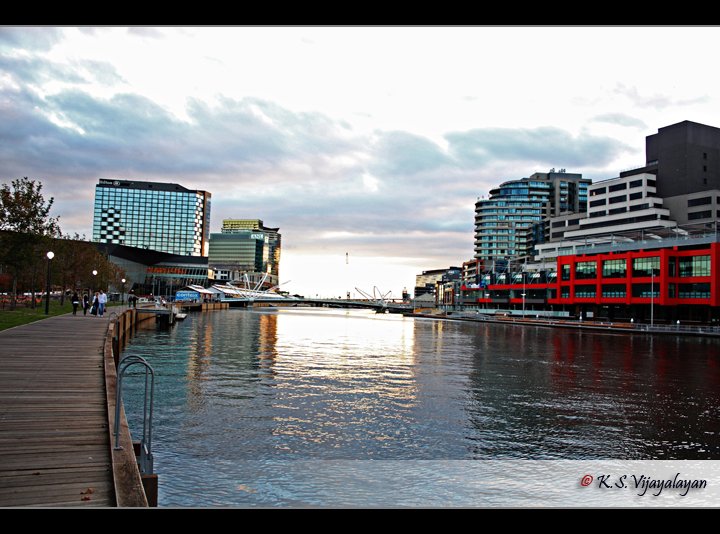 the way to Melbourne Convention Centre
 Spencer street bridge
 Seafarers bridge