Sunday, September 19, 2010

Yarra trams, Melbourne

Tram is the most common mode of public transport in Melbourne and Yarra Trams is the sole operator. Melbourne has got the largest tram network in the world with 249 kilometres of double track. Everywhere in the city you can see web of cables powering the trams and roads shared with tram tracks.

Among the trams, the W class wooden beasts of 1950s are my favourites. A number of them are serving the tourists on the city circle loop offering free hop-on and hop-off tours around the city. I addition, three such classic trams are also operating as 'The Colonial Tramcar Restaurants' which require reservations at least one month in advance and under 5 years old babies are not allowed.

Classic W class tram offering free City Circle service

Z3 class Australian built tram

D2 class tram (made in Germany)

C1 class tram (made in France)

C2 class tram / BumbleBee (made in France)
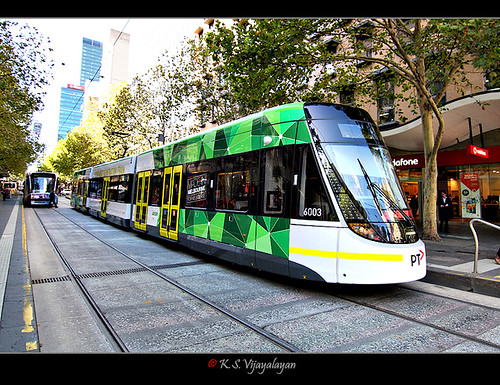
Yarra Tram
E class tram

Web of tram power-lines

Thursday, July 1, 2010

Birds of Dandenong Ranges, Australia

Grants picnic area of Sherbrooke in Dandenong Ranges is one of the best places in Australia for bird lovers, where people can closely watch and feed brilliantly coloured Australian King Parrots and Crimson Rosellas, as well as Sulphur-crested Cockatoos. In addition, Galahs and Long-billed Corella are also frequent visitors to that spot. The Lyrebird trail through lush green ferns and trees offers a wonderful trekking experience and the lucky ones get siting of Superb Lyrebirds if they walk without disturbing the serene environment.

Here are some of the shots I took during my 1/2 day visit to the park.


Australian King Parrot (male)


Crimson Rosella


Crimson Rosella (Juvenile)


Galah


Sulphur-crested Cockatoo


Long-billed Corella


Superb Lyrebird

Lyrebirds are ground-dwelling Australian native birds, and well known for their extraordinary mimicking ability of both natural and artificial sounds. Like Peacocks, male Lyrebirds perform a beautiful courtship display with their tail fanned out.

There is an interesting clip of Lyrebird from BBC wildlife hosted in youtube at http://www.youtube.com/watch?v=VjE0Kdfos4Y .

The Lyrebird trail

See also:

Thursday, May 20, 2010

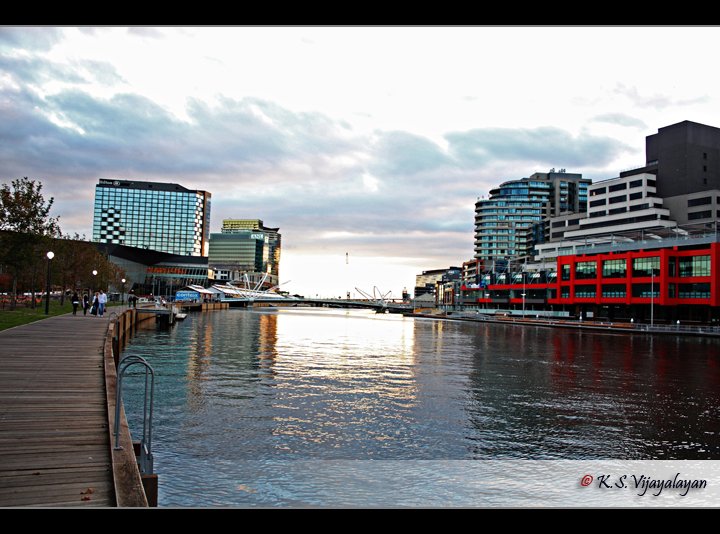
A walk along the banks of Yarra River, Melbourne

City's skyline and Princes bridge

City's skyline over Yarra river

City's skyline over Yarra river

View of Yarra river from Pricess bridge

View from Pricess bridge

Southgate footbridge

Southgate footbridge

View from Sandridge bridge

Sandridge bridge

Queens bridge

Melbourne aquarium

the way to Melbourne Convention Centre

Spencer street bridge

Seafarers bridge

Tuesday, April 13, 2010

Star effect from street lights

Venetian Causeway, Miami, FL, USA ( F=22, Exposure time=15 sec, ISO=400)

The "Star effect" is a stunning phenomenon in nocturnal photography that can be captured by reducing the aperture size (ie, increasing f-number) of a camera's lens whenever there is light source small enough when compared with the whole view. As a rule of thumb, selecting f-number greater than or equal to f/18 (i.e., f/18, f/20, f/22) makes the bright light sources like street-lights, vehicle lights, etc appearing like stars. The number of blades that make up the iris (or aperture) of the lens dictates the number of points on a star-burst.

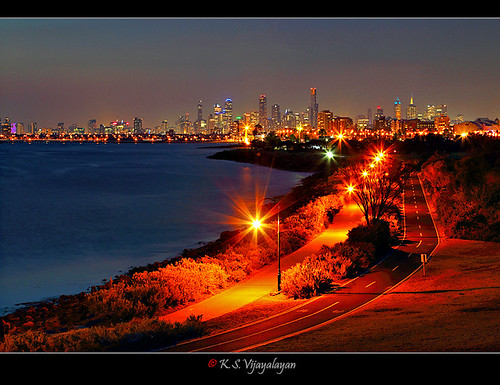
Melbourne CBD (F=20, Exposure time=30 sec, ISO=100)

It has to be noted that shooting in the dark and small apertures results in very slow shutter speeds. Hence, a camera stabilizer, e.g., a tripod, is essential.

Melbourne
View of Melbourne (F=22, Exposure time=30 sec, ISO=100)

There are "Star effect" filters available with different numbers of points (Eg: 4, 6 or 8) to enforce star effect even at lower f-numbers for relatively higher shutter speeds. Even though star effect filters help to create star like appearance of street lights with cameras possibly hand-held, the 'artificial' effects tend to be artificial and less attractive.

Thursday, April 8, 2010

Ticks of time

Exposure time = 10 sec, f = 32, ISO = 200

In photography slow shutter speeds help to capture motions. One interesting subject for such photography is the discrete motion of a second arm of a clock.